



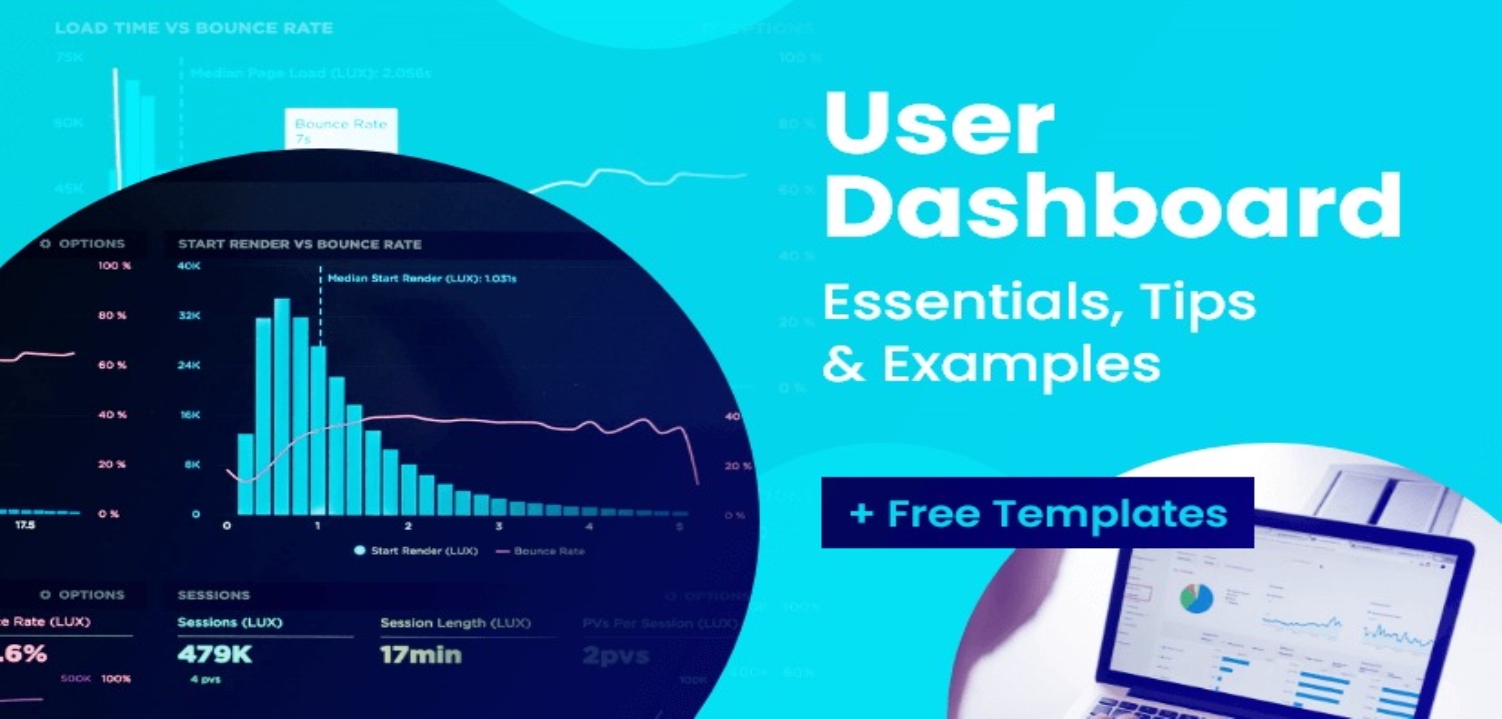
User Admin Dashboard Template must display data relevant to their task at hand, saving time and providing valuable insights for their use. Furthermore, it’s crucial that this data be automatically updated.
Admin dashboards are created for specific teams of users and should be straightforward and intuitive, while their design should remain uniform across platforms.
User Dashboard
User dashboards offer users with an overview of information relevant to their roles. It should be updated frequently so that data remains accurate and reliable, while being easily navigable – for example by clicking a graph and viewing usage stats over time.
To create a user dashboard that is useful to the company as a whole, designers must first understand what each role in the company wants from its data and metrics displayed. An IT manager’s dashboard may differ significantly from that of a marketing expert’s through labelling, grouping related visualizations together and providing clear statistical and verbal descriptions. Furthermore, key information must be easily understandable without cluttering it with irrelevant details; users must be able to explore points of interest highlighted within summarized data summarizations.
The User Dashboard add-on allows you to display a personalized dashboard for each user with their Quiz/Survey Information such as Quiz Name, Score, Time Taken and Downloadable Certificate Link as well as their custom Results Page template – providing them with more insight into their performance and progress. It’s an effective way of keeping users more aware of their performance and progress.
Admin Dashboard
An administrative dashboard is a crucial element of data management within your business, providing key information and tasks-to-be-done in an easily understandable way to help make quick and accurate decisions quickly and accurately. It also keeps you focused on the most pressing work at hand, and serves as an excellent means for tracking ongoing projects’ statuses. In addition to displaying key data, an admin dashboard should also easily customized for specific users or teams as well as flexible enough for easy time scale adjustments, zooming charts/indicators zooming, sub tables/other dashboards/timescale alterations as well as include search function so you can quickly locate information you require quickly.
The user dashboard offers a summary of your activities on, such as jobs, campaigns and postings. In addition, it shows details about you as a user – such as unique users active at any one time based on filters you set – updated every 30 days.
Operational Admin Dashboards are created to monitor real-time data and transactional information against key metrics in real time, making this a popular dashboard found both commercial software applications and consumer apps. With frequent updates that serve to highlight MRR growth rates over time, this type of dashboard updates frequently and is ideal for day-to-day monitoring activities. Other types of dashboards update less often but still highlight key performance indicators over a longer period, like MRR growth rates.
Operational Dashboard
Operational Dashboards monitor critical data to help you effortlessly track key performance metrics. Constantly updated, they serve your daily workflow and speed decision-making processes quickly and are designed for quick decision making processes. They typically track metrics such as:
An operational dashboard would be particularly helpful to social media platforms in providing new users, bounce rates, follower counts, comments and returns – information which is crucial to the success of your product or service. Furthermore, an operational dashboard displays real-time transactional data to give an understanding of how well your business is doing.
Executives often utilize an executive dashboard to track KPIs and make decisions, with less frequent updates compared to an operational dashboard, often focusing on trends or performance over a specified time period.
As you design an admin dashboard, it’s crucial that you understand both your audience and their needs. Along with providing all relevant data, the dashboard should feature an easy and clean design which makes navigating it a pleasure. Furthermore, it should offer multiple perspectives such as filtering values on a temporary basis or auto-syncing and updating data from relevant web APIs, spreadsheets or databases automatically; additionally it should incorporate visual data visualization to show trends and patterns more clearly.
Financial Dashboard
Financial dashboards aim to offer a clear and comprehensive view of a company’s finances, offering key indicators that enable stakeholders to make informed decisions. Such indicators could include revenue, expenses, profit and cash flow figures as well as areas of potential risk or opportunities for growth.
Financial dashboards must be designed with clear and concise language in order to effectively engage users and make sense of data relevant to them. A financial manager might wish to see only metrics that affect their business in order to make better decisions.
Conclusion
One of the key aspects of an effective financial dashboard is its ability to communicate data in an understandable manner. Furthermore, its structure should allow users to easily locate any needed information – saving both time and money in doing so. In addition, customizing its interface should be straightforward so users can design customized dashboards that meet their own specific goals easily; and lastly it should be easy and quick to set up and maintain as this can often take several hours per dashboard to get up and running successfully.
