



Introduction
In the realm of geometry, understanding the foundational concepts is crucial for building a solid mathematical framework. One such concept is the definition of an angle, a fundamental element that plays a central role in various geometric principles. In this article, we will delve into the undefined term used to define an angle and its significance in geometry.
- The Nature of Undefined Terms
- Foundations of Geometry: Geometry, as a mathematical discipline, starts with a set of basic ideas or undefined terms. These terms serve as the building blocks for more complex geometric concepts.
- Undefined for Precision: Undefined terms are not explicitly defined because they are considered intuitive and universally understood. Attempting to define them could lead to circular reasoning or unnecessary complexity.
- The Crucial Undefined Term: Point
- Point as the Cornerstone: The term “point” is one of the three essential undefined terms in geometry, alongside “line” and “plane”. A point is a fundamental notion that represents a specific location or position in space.
- Defining an Angle: A Relationship Between Points
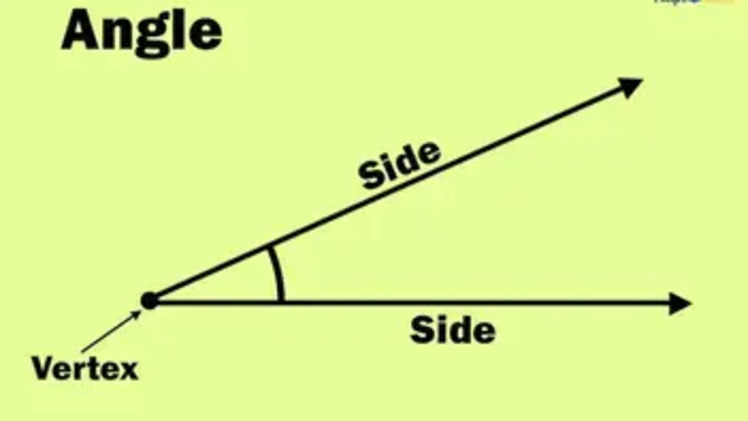
- Definition of an Angle: An angle is formed by two rays that share a common endpoint, known as the vertex of the angle. These rays extend from the vertex in different directions, creating a measurable opening.
- The Vertex as the Critical Point: The vertex is the key to defining and understanding angles. It is the point around which the rays rotate to form the angle.
Rays: Extending from the Vertex
- Understanding Rays: A ray is a straight path that extends infinitely in one direction. It is characterized by its starting point (the endpoint of the angle) and the direction in which it extends.
- Role of Rays in Angle Formation:
- Initial Ray: The first ray is known as the initial side. It provides the starting point for measuring the angle.
- Terminal Ray: The second ray, known as the terminal side, extends from the vertex in a specific direction, determining the size and direction of the angle.
Measuring Angles: Degrees and Beyond
- Units of Measurement: Angles are typically measured in degrees. A full revolution around the vertex constitutes 360 degrees.
- Beyond Degrees: Angles can also be measured in radians, a unit commonly used in advanced mathematical applications, particularly in calculus and trigonometry.
- Practical Applications of Angles
- Navigation and Astronomy: Understanding angles is crucial in navigation, where headings and bearings are expressed in degrees. Similarly, in astronomy, angles play a vital role in celestial navigation and studying the positions of celestial bodies.
- Engineering and Architecture: Angles are essential in the design and construction of structures. Engineers and architects use angles to create stable and aesthetically pleasing designs.
Conclusion: The Foundation of Geometric Understanding
In the world of geometry, the definition of an angle relies on the concept of a point, an undefined term that forms the basis of geometric understanding. By comprehending the relationship between rays and the pivotal role of the vertex, we can measure and manipulate angles, enabling us to explore the rich and diverse field of geometry. Whether applied in navigation, engineering, or astronomy, angles are a cornerstone of mathematical reasoning and play an indispensable role in our understanding of the physical world.
